

If your loved one was recently diagnosed with dementia, you probably have a lot of questions: Are dementia and Alzheimer’s the same thing? What’s the difference? How long will my mom not be able to live at home anymore? How will I know when it’s the right time to consider moving my dad to a specialized memory care community? Dementia is a progressive disease, which means it gets worse over time, but it progresses differently in everyone. Symptoms can range from mild memory loss to more severe cognitive difficulties that make it hard to manage daily activities without help.
The Reisberg scale for measuring dementia
Dementia symptoms are broadly grouped into stages. A commonly used seven-stage dementia scale is the Reisberg Scale, named after its creator (more formally the Global Deterioration Scale for Assessment of Primary Degenerative Dementia).
Dividing dementia into stages helps healthcare professionals measure as the disease progresses. Becoming familiar with the stages of dementia can also give you and your family members a general idea of what your loved one’s future may hold so you can make plans accordingly.
Early stage dementia: the first signs
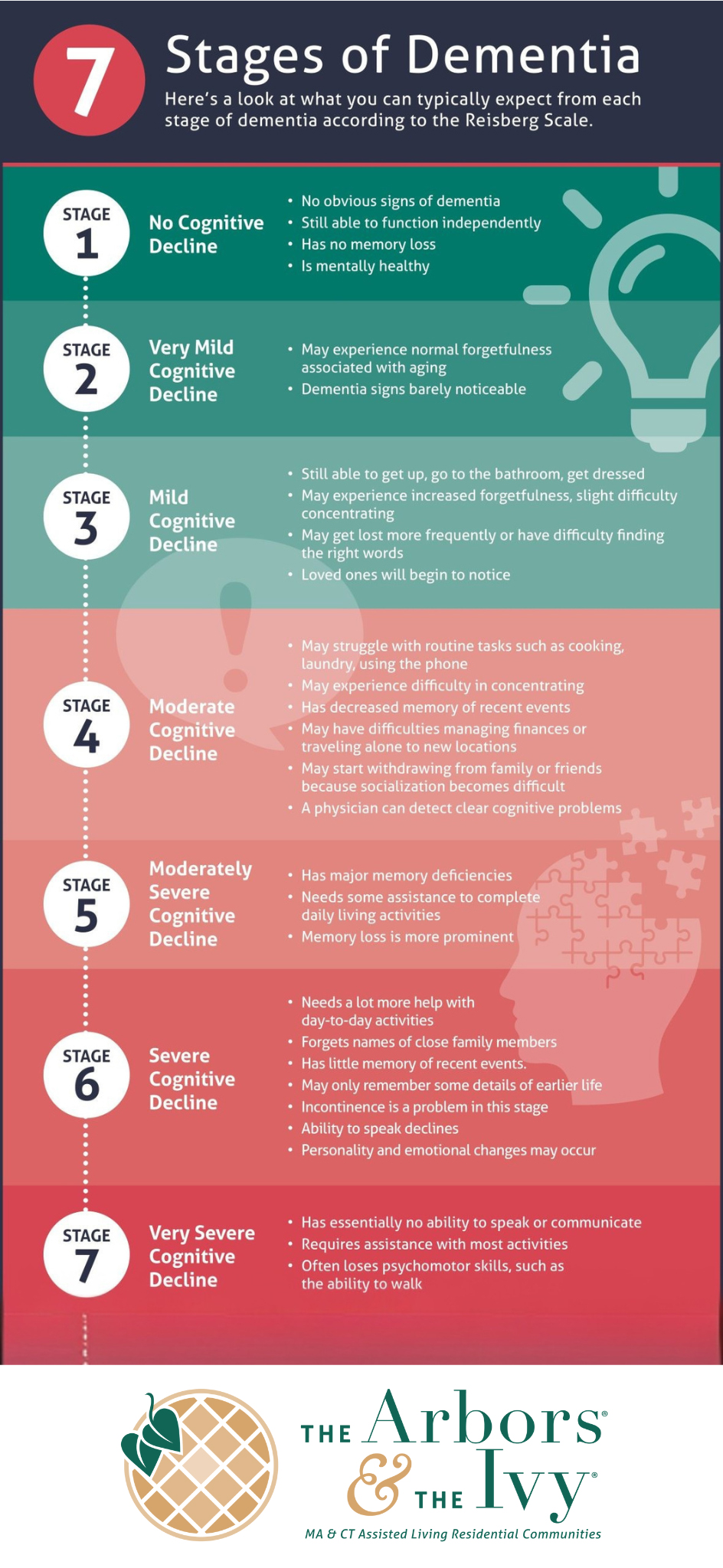
Pre-dementia is marked by mild cognitive decline. This includes occasional forgetfulness such as misplacing objects or struggling to find words. These lapses often resemble typical aging and do not affect independence.
Gradually, clearer lapses show up: for example, forgetting familiar words, difficulty with complex tasks, organizing schedules, or managing finances. Family and close friends may begin to notice changes. This is a common time to request a medical evaluation to rule out reversible causes and establish a baseline.
Stage 4 of 7 on the Reisberg Scale is considered early dementia, marked by moderate cognitive decline. Short-term memory loss becomes more apparent, managing bills or travel is harder, and problem-solving takes more effort. Many people still live at home, yet they may benefit from help with finances, medication setup, meal planning, and transportation.
Helpful steps in early stages:
- Schedule a comprehensive medical evaluation, including medication review and screening for depression, sleep problems, or vitamin deficiencies.
- Start conversations about preferences for care, living arrangements, and future support.
- Begin a simple home safety check, for example securing throw rugs, improving lighting, and labeling cabinets.
Middle stage dementia: more severe cognitive impairment
As dementia progresses past mild cognitive impairment into the middle stages, people require daily support and closer supervision. With moderately severe dementia (Stage 5), your loved one will need assistance with more complex activities of daily living, such as selecting appropriate clothing, managing appointments, and preparing meals. Orientation to time or place may be inconsistent. Gentle structure, a regular routine, and cueing are very helpful.
During severe cognitive decline (Stage 6 on the Reisberg Scale), memory loss extends to more distant events, and individuals may need help with dressing, bathing, toileting, and eating. Sleep changes, wandering risk, and behavior or mood symptoms can increase. By this stage, it usually becomes unsafe to leave a person alone for extended periods.
Moving into late stage dementia: very severe cognitive decline
The final stage of dementia is marked by very severe cognitive decline. Individuals with very severe dementia lose the ability to communicate clearly and require total assistance for personal care. Mobility decreases, swallowing can become difficult, and weight loss or infections may occur. Comfort, dignity, and one-on-one support are central goals for late stage dementia patients. Families often partner with specialized memory care teams to ensure round-the-clock supervision and compassionate care.
Care tips for advanced dementia:
- Maintain a calm daily rhythm with consistent wake, meal, and bedtime routines.
- Simplify choices: for example, offering two clothing options rather than many.
- Use clear, short sentences and visual cues.
- Review safety needs, including door alarms, grab bars in bathrooms, and a plan for medical emergencies.
Dementia symptoms across the seven stages
Here is a further breakdown of what you can typically expect from each of the seven stages of dementia. In the below scale, seniors in the first two stages typically do not exhibit enough symptoms for a dementia diagnosis. A diagnosis might be made as early as Stage 3; some people are already in Stage 4 or even later. Stages 5 and 6 are considered middle dementia, and Stage 7 is considered late dementia. It’s important to note that the stages are approximations, and not everyone will have every symptom or progress at the same rate.
When is the right time for memory care?
During the fourth stage of dementia, it is a good idea for caregivers and loved ones to discuss and make decisions about the future. For example, a long-term care plan should be made and financial and legal matters put in place. By Stage 6, it usually becomes no longer safe to leave the individual alone, which means supervision is necessary.
At some point, the individual will be 100 percent dependent on their caregiver and will no longer be able to complete any daily living activities on their own. Not all families are equipped to offer this level of care. There are other options for care, such as hiring a part-time caregiver or moving your loved one to a memory care community.
It is important to remember that the stages of dementia are somewhat fluid. Use them to help plan for future changes and to work with your doctor to develop solid treatment and long-term care plans. To learn more about your long-term care options, download our eBook guide for family caregivers on how to know when it is the right time to consider moving an elderly parent or loved one to a memory care community.
Practical signs that additional support may be needed:
- Repeated safety incidents such as leaving the stove on, wandering outside, or frequent falls
- Increasing caregiver burnout, such as sleep loss, stress, or missed work because supervision is required
- Personal care needs that exceed what can be provided at home, such as lifting, transfers, or help with toileting and bathing
- Medical complexity such as swallowing problems, weight loss, or multiple medications that require careful management
How specialized memory care helps:
- 24/7 trained staff who understand dementia communication and behavior
- Secure environments that reduce the risk of wandering and injury
- Structured daily routines with meaningful activities that support dignity and autonomy
- Care coordination with physicians, plus on-going family updates
If you want to talk through options or schedule a visit, explore our memory care community or review our planning resources in the free eBook.
How doctors use staging alongside diagnosis
The seven different stages of dementia describe overall function, but do not replace a medical diagnosis. Clinicians consider medical history, cognitive testing, brain imaging when appropriate, and changes in daily function. The Reisberg Scale is one helpful framework. Other tools you may hear about include the Clinical Dementia Rating and the Functional Assessment Staging Test. Research continues to clarify how Alzheimer’s affects the brain, which can inform care planning over time.
Caregiver wellness matters
Caring for someone with moderate dementia is meaningful, and it can be demanding. Brief daily habits can protect your health and sustain your ability to care for your loved one:
- Keep regular medical appointments and share any new stress or sleep issues with your provider.
- Stay active with short walks or stretching, and prioritize 7 to 9 hours of sleep when possible.
- Accept help from friends, family, or respite services. Even a few hours off can make a difference.
- Join a support group in your area or online to connect with other caregivers.
FAQs about dementia stages and memory care
How fast do people move through the seven stages?
Progression is highly individual. Some people spend years in early stages with minor changes, while others move to advanced stages more quickly. Health conditions, social support, and environment all influence pace. Staging is a guide for planning, not a precise timeline.
Is dementia the same as Alzheimer’s disease?
No. Dementia is an umbrella term for symptoms that affect memory, thinking, and daily function. Alzheimer’s disease is the most common cause of dementia. Learn more: Dementia vs. Alzheimer’s.
When should we start legal and financial planning?
Ideally by Stage 4, while your loved one can share preferences and participate in decisions. Start with powers of attorney, advance directives, and a review of finances. Visit our guidance on key legal documents to help you prepare.
What safety steps help during middle stages?
Create a consistent daily routine, simplify choices, lock up hazardous items, add grab bars and nightlights, and consider door or bed alarms. Regular medication reviews and hydration checks are helpful as well.
When should we consider a move to memory care?
Consider a move if safety incidents increase, medical or personal care needs outpace what is realistic at home, or caregivers are experiencing burnout.
What Our Memory Care Patients and Families Say about The Arbors & The Ivy
My husband’s Aunt Marlene is one the first residents in the memory care unit. She is very happy and we are very pleased with the accommodations and prices. The staff is well trained and caring. The receptionist, Cindy, is very warm, caring and respectful with an outgoing personality. We would recommend The Ivy to anyone looking for a special place for a loved one. Cecile C. – The Ivy at Ellington
Clinical Reviewer

