

When your parent needs more support and care, choosing the right level of care can feel overwhelming. Many families find themselves deciding between assisted living vs. skilled nursing, unsure which option truly meets their loved one’s needs.
Both assisted living and skilled nursing provide care, but the type of support, medical oversight, daily life, and costs are very different. Understanding those differences can help you move forward with clarity and confidence as you explore options for your parent.
Quick answer: Assisted living vs. skilled nursing
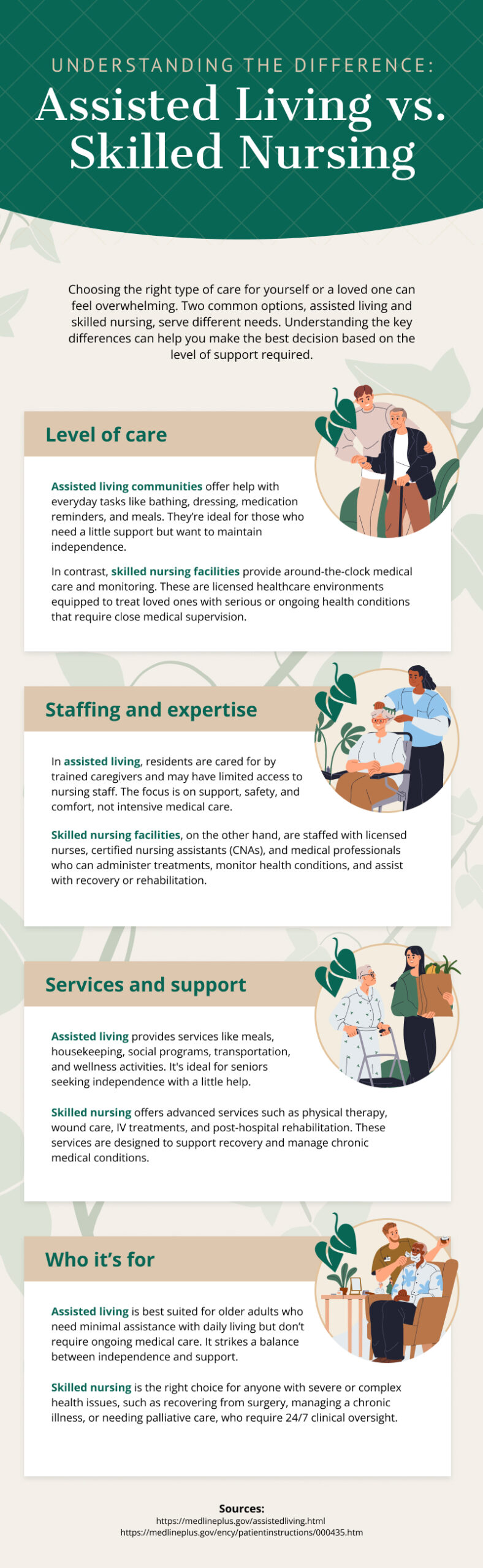
Assisted living provides help with daily activities like bathing, dressing, and medication management in a residential community setting. Skilled nursing facilities (SNFs) provide 24/7 licensed medical care, rehabilitation services, and close monitoring for people with complex or post-hospital medical needs.
Key takeaways:
- Assisted living supports independence with help for activities of daily living (ADLs).
- Skilled nursing facilities (SNFs) provide round-the-clock licensed nursing care.
- Skilled nursing is often short-term after hospitalization, though it can become long-term in some cases.
- Assisted living is typically private pay, while Medicare may cover short-term skilled nursing after a qualifying hospital stay.
- Rehabilitation services are central to skilled nursing care.
- The right option depends on medical complexity, supervision needs, and overall health stability.
What is assisted living?
Assisted living is designed for people who are generally independent but need help with activities of daily living (ADLs) such as bathing, dressing, or managing medications. These communities provide a residential setting where residents can maintain independence while receiving support when needed.
Residents typically live in apartment-style accommodations and enjoy restaurant-style dining, daily social activities, and transportation services. The goal is to help residents stay active, connected, and supported while maintaining as much independence as possible.
Families researching care options often start by exploring assisted living communities in CT, where residents can benefit from both independence and daily support.
What support does assisted living provide?
Assisted living communities typically offer:
- Assistance with ADLs such as bathing, dressing, grooming, mobility, and eating
- Medication reminders or administration
- 24/7 staffing nursing staff available
- Monitoring of health and wellness
- Restaurant-style dining and nutritional services
- Weekly housekeeping and linen services
- Social activities, spiritual services, and wellness programs
- Scheduled local transportation for appointments and errands
At The Arbors & The Ivy, residents live in private apartments within a vibrant community where care plans can be adjusted based on individual needs.Who is assisted living best for?
Assisted living may be a good fit when someone:
- Needs help with one to three ADLs
- Benefits from medication reminders
- Feels isolated living alone
- Wants more social engagement and community life
- Does not require 24/7 licensed medical supervision
Common misconception
Assisted living is not the same as a nursing home. It is a residential community that balances independence with personalized support.
What is skilled nursing (SNF)?
A skilled nursing facility (SNF)—often called a nursing home—provides 24/7 licensed medical care for individuals with serious health conditions or those recovering from surgery or illness.
These communities are staffed by licensed nurses and healthcare professionals who deliver specialized services such as:
- Wound care
- IV therapy
- Physical therapy
- Occupational therapy
- Speech therapy
- Regular vital sign monitoring
Skilled nursing is appropriate for anyone who requires ongoing medical attention and cannot be supported in an assisted living setting.
How admission typically works
Skilled nursing admission is often:
- Physician-directed
- Recommended during hospital discharge planning
- Covered temporarily by Medicare after a qualifying hospital stay
Who is skilled nursing best for?
Choose skilled nursing when someone:
- Requires constant medical supervision
- Is recovering from surgery or serious illness
- Has complex medical needs that cannot be managed in assisted living
- Needs daily rehabilitation services
- Requires IV medications, ventilator support, or advanced wound care
Who needs skilled nursing vs. assisted living?
Many families ask: Is skilled nursing the same as assisted living? The answer is no. The deciding factor is the level of medical complexity and supervision required.
Choose skilled nursing when:
- There has been a recent hospital discharge
- Daily rehab is required
- The individual has unstable or advanced medical conditions
- Complex wound care or IV therapy is needed
- Two-person transfers are required
- Continuous monitoring is medically necessary
Assisted living may be right when:
- Health is stable, but support is needed with daily tasks
- Medication reminders or limited administration are needed
- Mobility has declined, but does not require intensive therapy
- Social isolation is a concern
- Independence remains a priority
If you’re not sure:
- Speak with your loved one’s primary care provider
- Request a functional assessment
- Review hospital discharge paperwork carefully
Cost considerations
The cost of care varies significantly between assisted living and skilled nursing communities. Families often begin evaluating long-term care options by researching the assisted living costs to better understand what services and levels of care are included.
Assisted living costs
Assisted living is generally less expensive because it provides non-medical support. It is typically paid privately, though long-term care insurance may cover certain services.
Skilled nursing costs
Skilled nursing is more costly due to 24-hour licensed medical care.
Medicare may cover skilled nursing for a limited period following a qualifying hospital stay. Medicaid may assist with costs for eligible residents.
Important distinction:
- Medicare does not cover long-term assisted living
- Medicare may cover up to 100 days of skilled nursing per benefit period if eligibility requirements are met
Daily life and environment
One of the biggest differences between skilled nursing and assisted living is the daily experience.
A day in assisted living may include:
- Breakfast in a restaurant-style dining room
- Flexible schedule
- Social programs and wellness activities
- Time for hobbies, outings, and family visits
- Personalized assistance as needed
Assisted living communities promote connection and engagement in a residential setting.
A day in skilled nursing may include:
- Scheduled medication administration
- Structured therapy sessions
- Ongoing medical monitoring
- Clinical coordination of care
- More regimented daily routines
Differences at a glance
Category
Assisted Living
Skilled Nursing (SNF)
Medical Oversight
Nursing 7 days/week; nurse on call
24/7 licensed nursing
Environment
Residential community
Clinical setting
Length of Stay
Long-term
Often short-term rehab
Rehab Services
Limited/third-party
Daily therapy on-site
Payment
Mostly private pay
Often Medicare/Medicaid eligible
Skilled nursing vs. nursing home vs. rehab
These terms are often used interchangeably, but there are distinctions:
- Nursing home: General public term
- Skilled nursing facility (SNF): Licensed center providing medical and rehabilitation services
- Rehab center: May exist within a skilled nursing setting or hospital
Skilled nursing vs. rehab:
Rehabilitation services are typically delivered within a skilled nursing community, but rehab alone does not define the level of medical supervision required. Families comparing levels of support may also look at the differences between in-home care and assisted living to determine which option provides the safest balance of independence and support.
Memory care vs. skilled nursing when dementia is involved
Memory care communities specialize in structured support for individuals living with Alzheimer’s disease or other forms of dementia.
Skilled nursing becomes necessary when dementia is accompanied by:
- Complex medical instability
- Advanced mobility limitations
- Medical treatments requiring licensed oversight
Consulting with a physician or geriatric specialist can help determine the appropriate level of care.
Can someone move from assisted living to skilled nursing?
Yes. Transitions sometimes occur when medical needs increase beyond what assisted living can reasonably support.
Transitions often involve:
- Hospital discharge planners
- Physician recommendations
- Collaboration between families and care teams
Planning ahead—before a crisis—can help families feel more prepared if care needs change.
Our family lives here, too: Let The Arbors & The Ivy be your loved one’s next home
At The Arbors & The Ivy, we understand that every resident has unique needs. As a family-owned organization, we are deeply committed to creating communities where older adults feel connected, supported, and engaged.
Our experienced directors and long-standing team members work closely with families to develop personalized service plans that promote independence while providing meaningful support.
If assisted living is the right fit, we would be honored to welcome your loved one into one of our communities.
If skilled nursing is the most appropriate next step, we can help you understand what to ask and how to plan. Contact The Arbors & The Ivy today or reach out online to learn more about how we can support your family’s next step.